

Crown Hair Transplant in Turkey
A crown hair transplant moves follicles from the back and sides of your scalp to the crown, the spiral at the top-back of the head. The crown is harder than the hairline: the hair changes direction around the whorl, it takes many grafts to cover, and the loss around it may still be spreading. Individual results vary.
What makes the crown different, why it can look thinner even after many grafts, whether to treat it now or later, and how it is planned together with the front.
How is the crown different from the hairline?
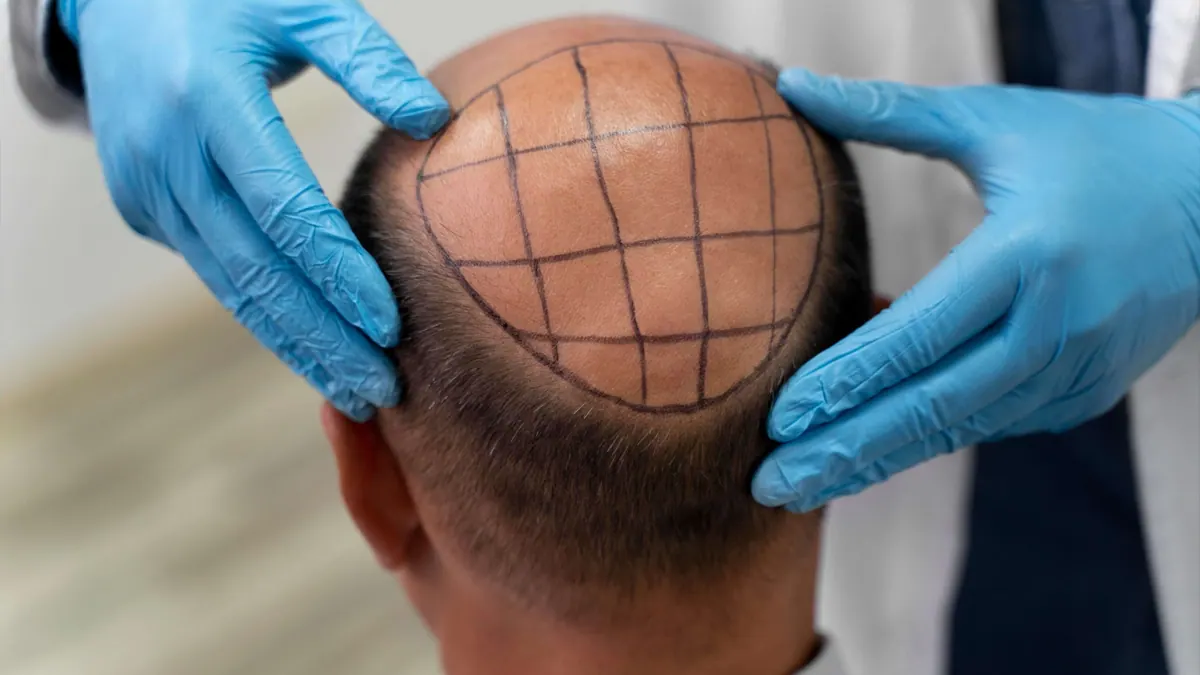
The crown, also called the vertex, is the area at the top-back of the head where the hair grows out from a central point. Thinning there is one of the typical patterns of male hair loss, and in some men it starts at the crown before the front recedes. Restoring it uses the same method as any FUE-based transplant, but almost everything about the planning is different.
| Crown | Hairline | |
|---|---|---|
| Direction of growth | Changes all the way round a central spiral | Mostly forward, at a low angle |
| How it is seen | From above and behind, often under overhead light | Face to face, framing the face |
| What makes it look full | Enough coverage to reduce the contrast with the scalp | A soft, irregular front edge of single hairs |
| How the loss behaves | Often widens outwards over the years | Often recedes backwards, at the temples first |
| Grafts needed to look covered | Many, for a wide curved surface | Fewer, but placed with great care |
Because you rarely see your own crown, its thinning often goes unnoticed until a photo from above shows it. That also means the result is judged from above and behind, in light that shows every gap. The hairline transplant page explains how the front is designed; this page covers the parts that only apply to the crown. Other ways of treating thinning hair are compared on hair restoration treatments.
Why does the whorl matter so much?
At the centre of the crown the hair turns around a single point, clockwise in some people and anticlockwise in others. Every hair leaves the scalp at a slightly different angle, and the direction changes as you move round the spiral and outwards from it.
Transplanted hair keeps the direction in which it was placed. So each graft has to be set at the angle and in the direction that the original hair grew at that exact spot. If the grafts all point the same way, the crown looks combed or planted rather than grown, and the hair sticks up or parts in the wrong place as it lengthens.
The pattern is usually read from the hair still present around the bald area and from photos taken before the scalp is shaved. Some people have two whorls, a double crown, and the plan then follows both. The centre point itself is not packed densely: in a natural crown the hair fans out from it, so a small, slightly open centre is part of what makes a crown look real.
Ask how the direction of your whorl will be mapped before the grafts are placed, and whether it is drawn on your scalp first.
Why does the crown take many grafts and still look less dense?
- For a first rough number, the hair graft calculator works from the size of the areas you want to treat.
- How grafts are shared between the front, the middle and the crown is explained in how graft numbers are planned.
- A firm estimate needs your crown, front and donor area seen together; a free hair analysis works from photos of all three.
The crown is a wide, rounded surface. Covering it needs grafts spread over a large area, and the area can grow if the loss around it continues. That is why a crown can use up a large part of what a donor area can give, and why its graft estimate is planned against your whole scalp rather than on its own.
Even with many grafts, the crown tends to read thinner than the front. The hair grows away from the centre in every direction, so looking down at it you see into the spiral rather than across a layer of hair lying the same way. Overhead light then reflects off the scalp between the hairs. At the front, the hair lies forward and overlaps, which hides more scalp with fewer grafts.
A realistic aim for the crown is coverage that softens the contrast between hair and scalp, not the density you had at eighteen. Thick, wavy or curly hair, and hair close to your skin tone, tend to cover more than fine, straight hair that is much darker than the skin.
Should you treat the crown now or wait?
Pattern hair loss usually progresses over the years. A transplant moves hair that is resistant to that loss into the crown, but it does not stop the hair already growing around it from thinning further. This is the central question for the crown.
| Your situation | What is often suggested |
|---|---|
| Crown loss has been stable for some time and the donor area is strong | The crown can be part of the plan now |
| Crown thinning is recent or still changing quickly | Watch it, and consider medical treatment, before using grafts on it |
| Front and crown are both thinning, donor area is average | Front first, with grafts held back for the crown later |
| Large, open crown with a limited donor area | Partial coverage, or other options such as medical treatment, may fit better |
If the crown is filled while the loss around it is still spreading, the new hair can end up as an island, with a ring of fresh thinning around it. Closing that ring later takes more grafts from a donor area that does not grow back. The front tells a different story: a hairline that recedes behind a transplant still frames the face, while a crown that widens around a transplant shows.
So the timing depends on how settled your loss is. Useful signs are how quickly the crown has changed over the last year or two, your age, the pattern in your family, and whether the front is also receding. Comparing photos taken from directly above, in the same light, months apart, is a simple way to see the trend. Where you sit on the Norwood scale gives a common language for describing it.
Which of these fits you is recommended at your assessment, with the reasons. A plan that leaves grafts in reserve is not a smaller plan; it is one that still works if your loss continues.
How is the crown planned together with the front?
Possible when the donor area is strong and the loss is settled. The grafts are shared out so that no area is left looking unfinished.
Often suggested when the donor area is average or the crown is still changing. Grafts are held back for the crown.
Can suit someone whose front is still full and whose crown has been stable. The plan still allows for the front thinning later.
Most people who lose hair at the crown also lose some at the front or in the middle, and both draw on the same donor area. Your donor area has to last a lifetime, so the plan starts with what it can spare in total and then divides it.
The front usually comes first, because it frames the face and changes how you look from every angle. The middle of the scalp joins the front to the crown; covering it well can make a thin crown less noticeable from the front and sides. The crown is then planned with what is left, either in the same session when the donor area allows it, or later.
A later crown session is a common, deliberate choice, not a sign that the first one failed. It lets the front grow in first, shows how your loss behaves in the meantime, and keeps grafts available where they will matter most. What a second session involves is set out on second hair transplant.
Can medical treatment help the crown?
The crown is often where medical treatment for pattern hair loss is tried first. Health and dermatology bodies such as the NHS, the British Association of Dermatologists and the American Academy of Dermatology describe medicines that may slow the loss and help some hair regrow in some people. They also note that these medicines do not work for everyone, that some need a prescription and can have side effects, and that the benefit generally lasts only as long as the treatment continues.
This matters for a crown transplant in two ways. Where it works, holding the existing hair can make the crown more stable before any grafts are used, and it may help keep the hair around the transplanted area afterwards. Whether a medicine suits you is a question for your own doctor, who knows your medical history.
Platelet-rich plasma is sometimes discussed for thinning hair as well; what it can and cannot be expected to do is set out on PRP hair treatment.
What to expect from a crown over the months
The transplanted crown hairs shed, rest and regrow on the same course as any other area; the hair transplant timeline covers each stage, with much of the result visible by 9–12 months. When results become visible can vary by scalp area and from person to person, so the crown and the front may not look ready at the same time.
Judge the crown from directly above, in the same light as your first photo, rather than in a bathroom mirror. Some of the existing hair around the crown can shed for a while after the procedure; this temporary shedding is explained on shock loss.
Over the longer term, the transplanted hair tends to keep growing, while the hair around it follows its own course. Keeping photos at regular intervals, and any medical treatment you have been advised, helps you see early if the area around the crown starts to thin. Individual results vary.
What does a crown hair transplant cost with Natural Hair Turkey?
A crown transplant costs one of our three package prices, between €1,600 and €2,100 (approx. $1,850–$2,400), for up to 5,000 grafts — the same as for the front or any other area, whatever the technique. Our guide to hair transplant cost in Turkey explains what each package covers.
Payment is taken in euros; dollar amounts are approximate.
Crown hair transplant: your questions
Can I have only my crown transplanted?
Will a transplanted crown look as dense as the front?
How can I tell whether my crown loss is still spreading?
Which photos help assess my crown?
What if I have a double crown?
Am I too young for a crown transplant?
Is crown thinning in women treated the same way?
Sources & further reading
- NHS (United Kingdom)
- British Association of Dermatologists
- American Academy of Dermatology
- International Society of Hair Restoration Surgery (ISHRS)
This content is for general information only and does not replace a personal medical consultation. Any procedure carries risks that are discussed during your assessment; individual results vary.
Related pages
 GuideHairline transplantHairline design and restoration — a natural,…Read the guide
 GuideFemale hair transplantIs a hair transplant right for you as a woma…Read the guide TrustHair transplant clinic checklistA practical hair transplant clinic safety ch…How we work
 GuideAfro Hair Transplant in TurkeyHow curled follicles are taken out intact, w…Read the guide GuideBeard Transplant in TurkeyBeard and moustache restoration with FUE/DHI…Read the guide GuideEyebrow Transplant in TurkeyEyebrow restoration for thin, over-plucked o…Read the guide GuideTemple Hair Transplant in TurkeyTemple hair transplant in Turkey: rebuilding…Read the guide
Want to know whether your crown should be treated now?
Send photos of your crown, front and donor area for a free hair analysis. We reply with an estimated graft range, how the crown fits with the rest of your scalp, and the package that applies, with no obligation to book.