

Hairline Transplant in Turkey
A hairline transplant moves single hairs and small follicular units from the back of your scalp to rebuild the front edge, designed to suit your age and face rather than to sit as low as possible. With Natural Hair Turkey it costs one of our three package prices, like any other transplant. Individual results vary.
What makes a hairline look natural, how its height and shape are chosen, how many grafts it takes, and how a transplant differs from surgical hairline lowering.
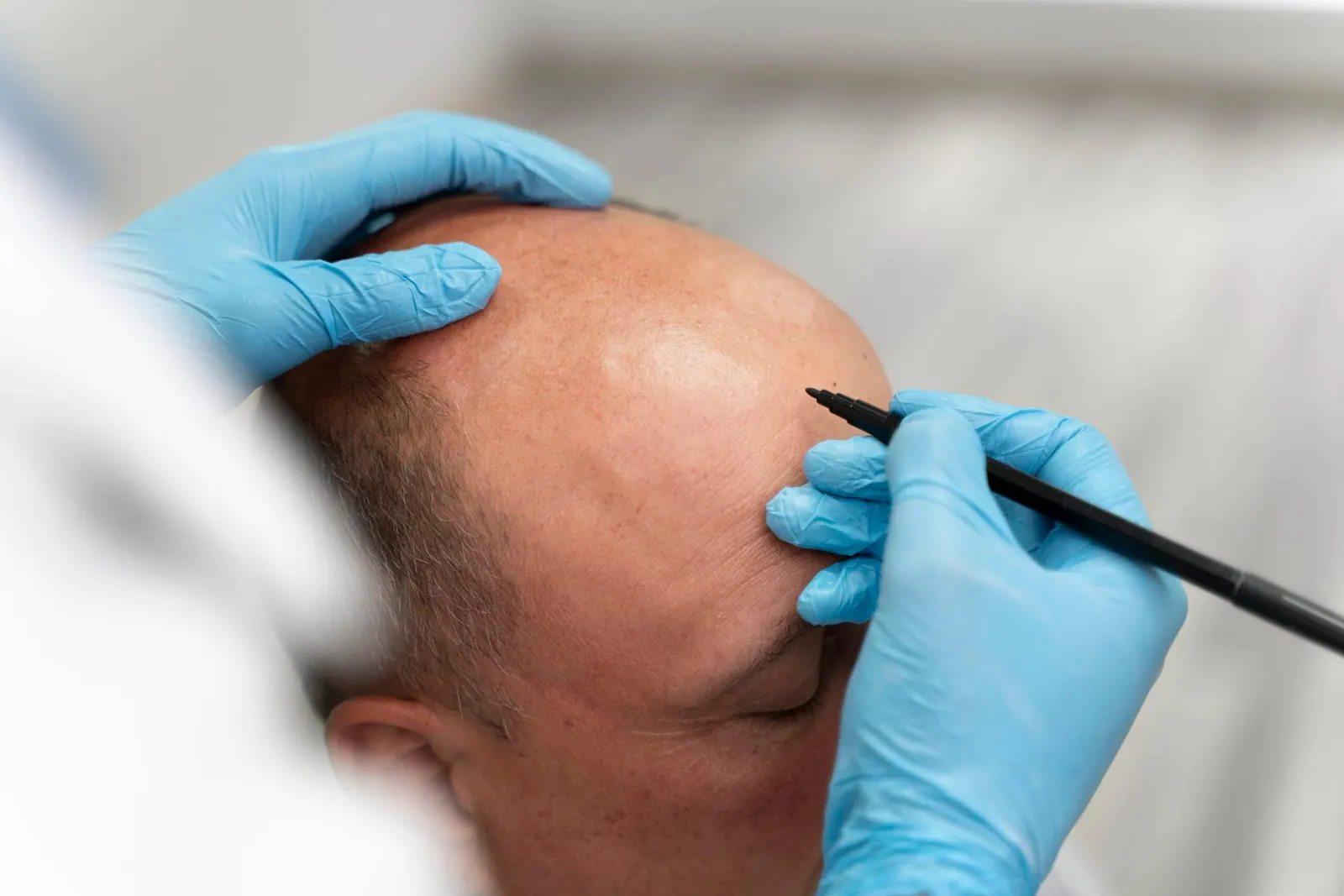
What makes a hairline look natural?
A natural hairline is not a line. Seen up close, the front edge is a soft band where single hairs grow sparsely and unevenly before the density builds up behind them.
| Detail | Looks natural | Gives a transplant away |
|---|---|---|
| Outline | Irregular, with small peaks and bays | Straight or perfectly symmetrical |
| Front row | Single hairs, spaced unevenly | Two- and three-hair grafts at the very edge |
| Angle | Low, pointing forward and slightly sideways | Upright, standing off the skin |
| Density | Builds up gradually behind the front | Full from the first row |
| Height | In proportion to your age and face | As low as the donor supply allows |
Most hairlines that look “done” fail on one of these details rather than on the number of grafts. A straight, dense edge can look striking in a photo taken a year after surgery and still look wrong in daylight, at a conversational distance, or ten years later.
How is a hairline designed for your age and face?
Design starts from the hairline you used to have, not from a template. Old photos help, and so does the faint line of fine hair that often survives at the front. The proposed line is drawn on the scalp, looked at from the front and the side, and agreed with you before the procedure starts.
Height is the decision that matters most over time. A transplant does not stop the loss of hair that has not been transplanted, so a line set very low in your twenties can look out of place in your forties if the hair behind it thins. A slightly higher, more mature line is often the better advice, especially while hair loss is still active.
The temples are part of the frame of the face. Rebuilding the corners changes how the whole face looks, and the hairs there lie at some of the lowest angles on the head, so they need careful planning. Female hairlines usually follow a rounder shape and are planned on their own terms; see female hair transplant.
If a proposed line looks too low or too straight to you when it is drawn, say so then: it is far easier to adjust a drawing than a grown-in hairline.
How many grafts does a hairline need?
It depends on three things: how far the hairline has moved back, how wide the area between the temples is, and how dense you want the front to look. Filling the corners alone uses far fewer grafts than rebuilding the whole front and blending it into a thinning mid-scalp.
Because the design comes first, the graft number follows from the drawing rather than the other way round. The hair graft calculator gives a first estimate from the areas you select; the number is confirmed when your donor area and the drawn line are assessed. A hairline is priced like any other transplant up to the package limit, so a smaller graft count does not change the price.
Single-hair grafts and the front row
Follicular units contain between one and four hairs. Sorting them after extraction lets the team place single-hair units at the very front, where a two- or three-hair graft would look coarse, and keep the larger units for the area behind, where they add density.
Placing the front row is slow, exact work. Each graft goes in at a low angle and in the direction the hair would naturally grow, close enough to its neighbours to look full but never in a straight row. Single-hair grafts are small and delicate, so the time they spend outside the body is kept short. Whether FUE or DHI is used for this step is decided case by case; how FUE and DHI differ explains the trade-off.
Hairline transplant or hairline lowering — which do you need?
Moves follicles one by one; suits a receding or thinning hairline; no cut along the forehead; the new line grows in over months.
Removes a strip of forehead skin; suits a naturally high hairline with dense hair; leaves a fine scar at the hairline; the new position is set during the operation.
A hairline transplant adds hair where it has been lost. Hairline lowering, also called forehead reduction, is a different, surgical operation and not a hair transplant: a strip of forehead skin is removed and the existing hairline is brought forward, which leaves a fine scar along the front. It is mainly considered when the hairline is naturally high but the hair behind it is still dense.
Which one fits depends on why your forehead looks high. A hairline that has receded because of hair loss usually points to a transplant; a naturally high hairline with strong hair may point to lowering; some people combine the two. If you are considering hairline lowering, it can be discussed at your consultation.
What your new hairline looks like, week by week
For the first days the front is pink, with small crusts that usually clear within about two weeks. The transplanted hairs then tend to shed around week 3, so for a few months the hairline can look much as it did before. New growth starts from about month 4, often fine at first, and the line is mostly in place by 9–12 months. The hair transplant recovery timeline covers each stage.
What does a hairline transplant cost?
A hairline costs the same as any other transplant with Natural Hair Turkey: one of three package prices, between €1,600 and €2,100 (approx. $1,850–$2,400), for up to 5,000 grafts, whatever the technique. Fewer grafts do not lower the price; the full package breakdown shows what each package includes.
Payment is taken in euros; dollar amounts are approximate.
Hairline transplant: your questions
Can a hair transplant fix a receding hairline?
Will my new hairline keep receding?
Do I have to shave for a hairline transplant?
Can women have a hairline transplant?
Can a hair transplant lower my hairline?
Is a hairline transplant permanent?
How soon can I go out without anyone noticing?
Is a hairline transplant haram?
Sources & further reading
- International Society of Hair Restoration Surgery (ISHRS)
- American Academy of Dermatology
- British Association of Dermatologists
- NHS (United Kingdom)
This content is for general information only and does not replace a personal medical consultation. Any procedure carries risks that are discussed during your assessment; individual results vary.
Related pages
 GuideHair Transplant in Turkey: Costs, Techniques and ResultsFUE, DHI and Sapphire FUE hair transplants i…Read the guide GuideTemple Hair Transplant in TurkeyTemple-point restoration to reframe the face…Read the guide
 TechniqueFUE Hair Transplant in TurkeyFollicular Unit Extraction (FUE) in Istanbul…How it works
 TechniqueDHI Hair Transplant in TurkeyDirect Hair Implantation (DHI) with implante…How it works
 GuideFemale Hair Transplant in TurkeyHair transplants for women — diffuse thinnin…Read the guide
 GuideAfro Hair Transplant in TurkeyAfro-textured hair transplants require speci…Read the guide
 GuideBeard Transplant in TurkeyBeard and moustache restoration with FUE/DHI…Read the guide
 GuideEyebrow Transplant in TurkeyEyebrow restoration for thin, over-plucked o…Read the guide
Ready to see a hairline drawn for your face?
Send a few photos for a free hair analysis. We suggest a hairline height, an estimated graft range and the package that applies — with no obligation to book.