

None of the rules after a hair transplant is hard on its own. The slips happen because they all arrive at once, often while you are tired, a little sore and far from home, and because the scalp starts to feel normal well before it has finished healing.
Below are ten mistakes that are easy to make, why each matters and what to do instead. Each links to the page that covers its topic in full.
1. Scratching when the scalp itches
Itching is part of normal healing, and it tends to strike when you are least careful: half asleep, or busy with your phone. Fingernails can lift the crusts, and a graft can come away with them. Gentle washing and any lotion your team gives you usually take the edge off; ask your team before trying anything else. More on managing itching after a hair transplant.
2. Washing too hard, or not at all
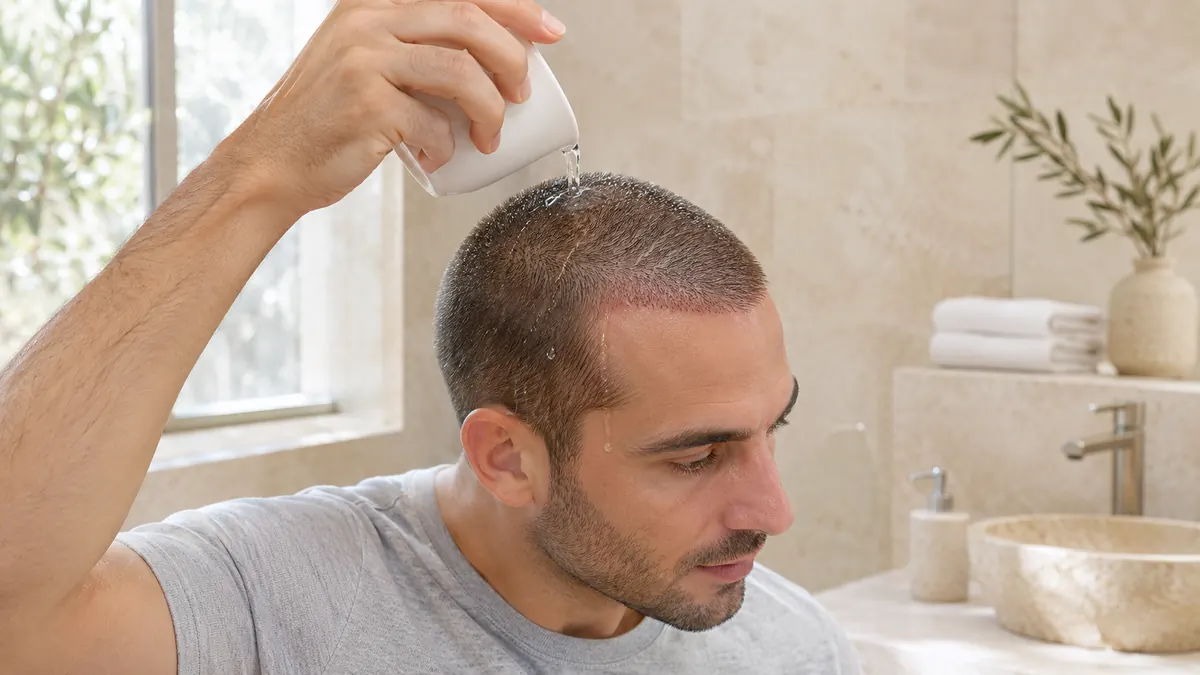
Rough washing is the familiar version: a strong shower jet, rubbing, hot water, or crusts picked off to speed things up. The opposite slip gets less attention: being so nervous that you skip washes, which leaves the crusts on the scalp for longer than they need to be.
Wash every day, exactly as you were shown, and the crusts usually come away by themselves within one to two weeks. Our guide to washing after a hair transplant goes through the routine.
3. Sleeping flat on the first nights
You can fall asleep propped up and wake on your side with the pillow pressed against your hairline. Raising your head also helps with the swelling some people get across the forehead early on.
For the first nights, and until your team says otherwise, sleep on your back with your head raised; a travel pillow makes rolling over harder. The set-up is on our page about sleeping after a hair transplant.
4. Adding a drink, a cigarette or a new pill
A drink to celebrate or a cigarette to settle the nerves can feel harmless once the operation is over. Your team may ask you to stay off alcohol and cigarettes for a time, because both can affect healing.
Medicines work the same way. Take what you went home with, as directed, and check with your team before taking any other medicine or supplement, however ordinary it seems. The rest of the essentials are on our hair transplant aftercare page.
5. Going back to the gym because you feel fine
Feeling well comes long before the scalp has finished healing. Sweat can irritate the treated skin, straining and knocks are the last thing fresh grafts need, and pools and saunas add water and heat.
Moderate cardio often comes back first, at around two weeks and once your team agrees, with heavier training later. Exercise after a hair transplant sets out the order.
6. Hiding the grafts under a tight cap
Wanting to cover the redness is understandable. A snug cap or beanie, though, presses and rubs on the very area you are protecting, and pulling it off can catch the grafts. Leaving the scalp in strong sun is the other half of this mistake.
A loose hood gives shade without touching the grafts, and a loose hat can follow once your team clears it. More on wearing a hat after a hair transplant.
7. Leaning on the headrest on the flight home
On the journey home, what matters is what touches your head: a headrest, a window you doze against, a bag lifted into the overhead locker. Sit so the treated area stays off the seat, use a neck pillow if it helps, and ask for a hand with heavy bags. Our page on flying after a hair transplant covers the trip from the clinic to your door.
8. Panicking when the new hairs fall out
Somewhere between weeks two and six, often around week three, many of the transplanted hairs shed. This is the point when people tend to worry that the transplant has failed. It is an expected stage: the follicles usually stay where they were placed and rest before growing new hair. Read more about shock loss after a hair transplant.
9. Judging the result too early
Early regrowth usually appears around month four, and the result matures at about 9–12 months. Comparing early, wispy growth with someone else's finished photo, or with how you looked before the shedding, makes the middle months feel worse than they are. Individual results vary.
Take a photo each month in the same light and compare it with your own starting point; the hair transplant timeline shows what each stage usually looks like.
10. Keeping a worry to yourself
Much of what you notice in the first weeks is ordinary healing, but waiting in silence is a mistake of its own. Redness that spreads or feels warm, pus, a fever, pain that grows instead of easing, or bleeding that will not stop with gentle pressure are reasons to message your team straight away, ideally with a photo.
Follow-up runs for 12 months with a named contact, whichever package you choose; your post-transplant follow-up explains how the check-ins work.
Planning a hair transplant?
Knowing these mistakes before the day makes the first weeks calmer. If you are still planning, the first step is a free hair analysis based on a few photos of your hair.
Get your free hair analysisSources & further reading
- NHS — Hair transplant
- American Academy of Dermatology — Hair loss: hair transplants
- International Society of Hair Restoration Surgery (ISHRS) — Patient brochure
This content is for general information only and does not replace a personal medical consultation. Any procedure carries risks that are discussed during your assessment; individual results vary.