

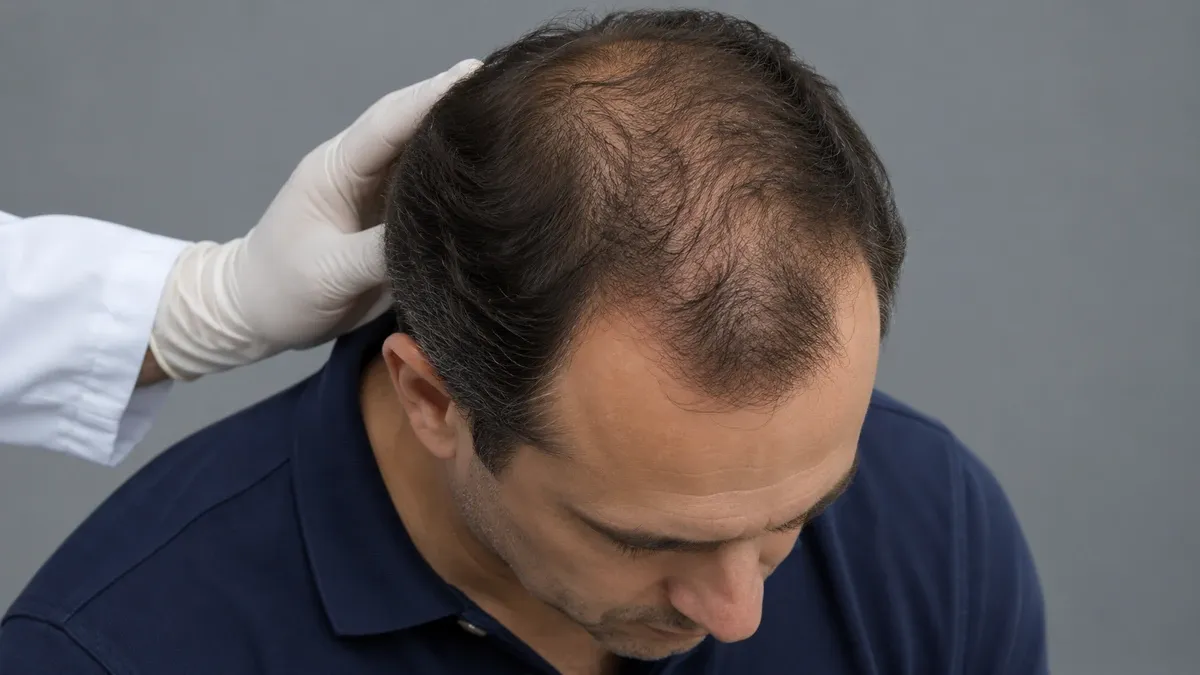
Age is one of the first things people bring up when they ask about a transplant: "Am I too young?" at one end, "Have I left it too late?" at the other. It is a fair question, but age is a clue rather than a rule. It hints at how far your hair loss may still go and how much donor hair you have to work with, and those are the things an assessment actually weighs.
Below are eight points that explain why, and what changes at different stages of life. Each links to the page that covers its topic in full.
1. Why there is no single right age
A transplant moves hair you already have, from the back and sides of the head, where it tends to resist pattern loss, to the areas that are thinning; it cannot create new follicles [1]. So the useful questions are about your hair, not your birthday. The AAD's conditions are about the scalp: a good supply of healthy donor hair, and thinning skin that can still grow hair [2]. According to the NHS, transplants are mainly for permanent hair loss that runs in families, not for most other kinds [3], and an assessment looks at your general health and what you hope for as well as your scalp [1]. The hair transplant candidate quiz asks about your age alongside these factors and gives a rough steer, not a diagnosis.
2. Stable, predictable loss counts for more than a birthday
Pattern hair loss tends to be gradual and progressive [1], so a plan works better when it can allow for what is still to come. Two people of the same age can be at very different points: one has had the same receding temples for years, while the other has watched the crown open up within a year. Photos taken from the same angles every few months, and the way your parents or older relatives lost their hair, help show which picture is yours. For male pattern loss, the Norwood scale gives a common reference for where your hair sits today.
3. Younger patients: why waiting is often the advice
The ISHRS puts the concern plainly: because hair loss tends to keep progressing, it is often unwise to start surgery in a patient who is too young [1]. The AAD notes that men in their twenties may be asked to wait and to start treating their hair loss with medicine first [2]. The worry is how a result will look later: a front rebuilt early can end up standing ahead of new thinning behind it. Our hairline advice for younger patients puts it in a few honest lines.
4. A young crown is hard to predict
The crown follows the same logic, and it is where the future is hardest to read. Grafts placed in a small bald spot today may end up in the middle of a larger one, so younger people are often told to track the crown for a while before using donor hair on it. Our page on planning a crown transplant explains how to tell whether crown loss is still spreading.
5. Medical treatment may come first, or alongside
Medicine is often part of the answer for a younger person, and it can matter at any age. The ISHRS describes medical treatment as a way to slow or prevent further hair loss and to help keep the hair behind transplanted areas [1]; the NHS points out that the main hair-loss treatments only work for as long as they are used [4]. Whether any medicine is right for you, and which one, is a decision to make with a doctor. Your team may suggest starting treatment before surgery is planned, particularly while your hair loss is still changing. The long-term maintenance plan page explains why the hair around a transplant needs looking after over the years.
6. Older patients: donor supply and general health
Starting later can have one advantage: the pattern may be clearer, so there is less guessing about what comes next. The questions shift instead. With age, many people see a slight loss of density all over the head [1], so how much donor hair is left to move carries more weight. Your general health carries more weight too: the assessment looks at it alongside your hair [1], and conditions or medicines that affect bleeding or healing are worth raising early, not on the day. The NHS names bleeding, infection and a reaction to the anaesthetic among the small risks any operation carries [3]; our page on hair transplant risks lists who should wait or think twice.
7. Women: the cause comes before the age
For women the first question is usually why, not when. Hair loss in women has a longer list of possible causes, and loss after an illness, stress, rapid weight loss or low iron can be temporary [4], while transplants are mainly for the inherited, permanent kind [3]. A transplant tends to suit women whose loss has settled and whose hair at the back and sides is still dense, and suits less well when thinning is spread evenly over the whole head. Our page on female hair transplant in Turkey explains how the cause is checked first.
8. Expectations, and the decades after
Whatever your age, the donor area is a limited supply, and a transplant does not stop the rest of your hair from changing: the AAD notes that thinning can continue after a transplant [2], and the NHS says a large area may need two or more sessions [3]. A plan made today should still look natural decades from now, so it is worth asking how much donor hair a plan leaves for later. For what a finished result usually looks like, see realistic hair transplant results.
Your scalp answers what your age cannot
Age gives a hint; your pattern, your donor area and your goals give the answer. A free hair analysis from a few photos of your hair is the place to start, with no obligation. Individual results vary.
Get your free hair analysisSources & further reading
- International Society of Hair Restoration Surgery (ISHRS) — Patient brochure
- American Academy of Dermatology — Hair loss: hair transplants
- NHS — Hair transplant
- NHS — Hair loss
This content is for general information only and does not replace a personal medical consultation. Any procedure carries risks that are discussed during your assessment; individual results vary.