

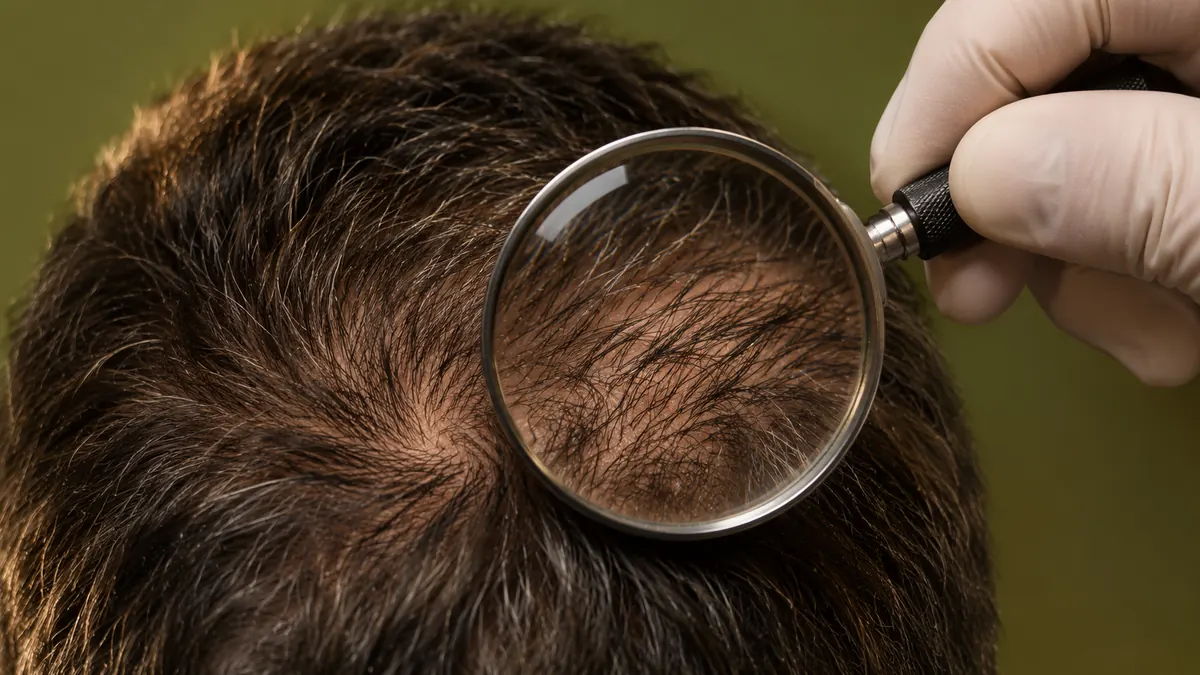
Many people still say "hair plugs" when they mean any hair transplant, and the phrase still carries an old image of an obviously transplanted hairline. If that image is what puts you off, it helps to know where it came from and what has changed since.
This post looks at what plugs were, why they looked the way they did, whether anyone still uses them, and what you can do if you already have them.
Hair plugs: the older form of hair transplant
Every hair transplant rests on the same observation. Hair at the back and sides of the head is usually genetically resistant to pattern loss, so it tends to keep growing after it has been moved to where hair is thinning [2]. A transplant redistributes hair you already have; it cannot create new follicles [2].
"Hair plugs" describes how that hair was moved in earlier decades. Back then, sections of hair called hair plugs were placed in the thinning area [1]. So do hair plugs work? They moved hair that grew, but the American Academy of Dermatology describes what patients were left with as unnatural, doll-like hair, and in time the plugs became quite noticeable [1].
Why plug results looked "pluggy"
Hair does not grow as evenly spaced single strands but in small natural groups of a few hairs, called follicular units [2][3]. A plug moved a whole section of hair to a single spot, and a hairline built from such sections could look abrupt rather than soft [1][2]. The ISHRS patient brochure contrasts that abrupt "pluggy look", commonly seen in hair transplants of years past, with the natural, feathered hairlines that very small follicular unit grafts made possible [2].
Graft size was not the only change. The AAD also credits improvements in how the hairline is created and how the hairs are placed in the thinning area for more natural-looking results [1]. The ISHRS brochure describes grafts being placed at the same angle as the hairs already present, without injuring the follicles around them [2].
| What to compare | Hair plugs (earlier decades) | Follicular unit grafts (today) |
|---|---|---|
| What is moved | Sections of hair, moved from elsewhere on the scalp [1] | Natural groups of a few hairs, called follicular units [2][3] |
| How the hairline can look | Abrupt; in time the plugs became quite noticeable [1][2] | Soft and feathered when the grafts are small and well placed [2] |
| How common | No longer the usual way; most transplants now move hairs a few at a time [1] | The usual approach today [1] |
So is a hair transplant just hair plugs today?
The principle is the same; the method is not. A transplant still moves your own hair from the back and sides of the head to the thinning area [1][2]. What changed is the unit that is moved: transplanting healthy hairs a few at a time is the key advance the AAD names [1].
The NHS describes how the grafts are taken today: either a thin strip of skin is removed and divided into small grafts, or the grafts are taken out one by one [3]. FUE, DHI and Sapphire FUE, the methods on our hair transplant techniques page, all take follicular units one at a time, and our FUE hair transplant page explains that method step by step.
Small grafts are not the whole story. The NHS says a transplant should be designed so that the hair looks natural as time passes [3], and the AAD notes that the outcome still depends largely on who you choose [1]. A modern method does not by itself make a result look natural; planning and placement matter as much.
Are hair plugs still done?
Not in the way the phrase suggests. Moving hairs a few at a time is now the usual approach [1]. The ISHRS brochure notes that some transplants also use slightly larger grafts, made of several follicular units, in the central scalp to build density, alongside single follicular unit grafts [2]. Older operations of a different kind, scalp reduction and flap surgery, are now performed only infrequently [2].
If a clinic, a forum or a friend uses the word "plugs", it is worth asking what is actually meant:
- Is a graft here a single follicular unit, or something larger?
- Are the grafts taken as a strip or one by one?
- How will the front edge of the hairline be shaped?
- Has the plan allowed for the hair around the transplant thinning later?
Clear answers to these questions tell you more about how a result may look than the name of the method does.
If you already have old plugs
Plugs, like transplants today, moved healthy hair from elsewhere on the scalp [1]; the difference lay in how that hair was grouped and placed. Over the years the hair around a transplant might continue to thin [3], which can leave older plugs with less of their own hair around them to blend into. The long-term maintenance plan page explains how the hair around a transplant is looked after over the years.
When someone has had grafts before, an assessment looks at that earlier work and at the donor hair that remains, as well as general health, hair texture and goals [2]. What can be changed depends on both. Our revision hair transplant page explains what repair work can involve and why it is usually more demanding than a first procedure.
Where the main concern is a hard, straight front edge, the hairline transplant page sets out how a hairline is planned today.
Looking at your own hair
Whether you are weighing up a first transplant or wondering what can be done about old plugs, the useful answer depends on your scalp and your donor area. A hair analysis from your photos is a first step; it is not a diagnosis, and what is possible is confirmed after a personal assessment. Individual results vary.
Get your free hair analysisSources & further reading
- American Academy of Dermatology — Hair loss: hair transplants
- International Society of Hair Restoration Surgery (ISHRS) — Patient brochure
- NHS — Hair transplant
This content is for general information only and does not replace a personal medical consultation. Any procedure carries risks that are discussed during your assessment; individual results vary.