Barttransplantation in der Türkei
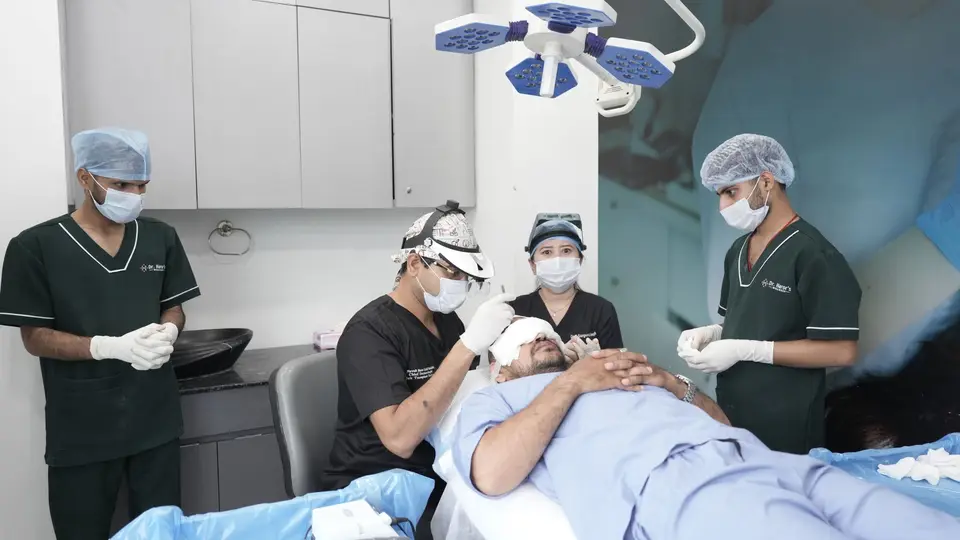
A beard transplant moves hair, usually from the back of your scalp, into a patchy or thin beard, moustache or sideburns, mostly as single-hair grafts set at the angle facial hair grows. It can fill gaps, cover a scar or build a fuller line. It is priced after an assessment. Individual results vary.
What a beard transplant can and cannot do, how the cheek line and neckline are designed, the moustache and sideburns, and the first weeks with a healing face.
Patchy beard, full beard or scar: what a transplant can do
Most people who ask about a beard transplant have a beard that grows, just not everywhere: gaps on the cheeks, a thin connection between moustache and chin, or an uneven neckline. Filling those gaps is the most common reason for the procedure. Others want to cover a scar, or to build a beard where very little grows.
What a transplant can do depends on two things: how much hair your scalp donor area can spare, and how dense a result you want. Scalp hair is a close but not identical match for beard hair in thickness and colour, so the plan takes both into account. Because a beard is a large area, full coverage needs many grafts; filling gaps needs far fewer.
Designing the cheek line, neckline and density
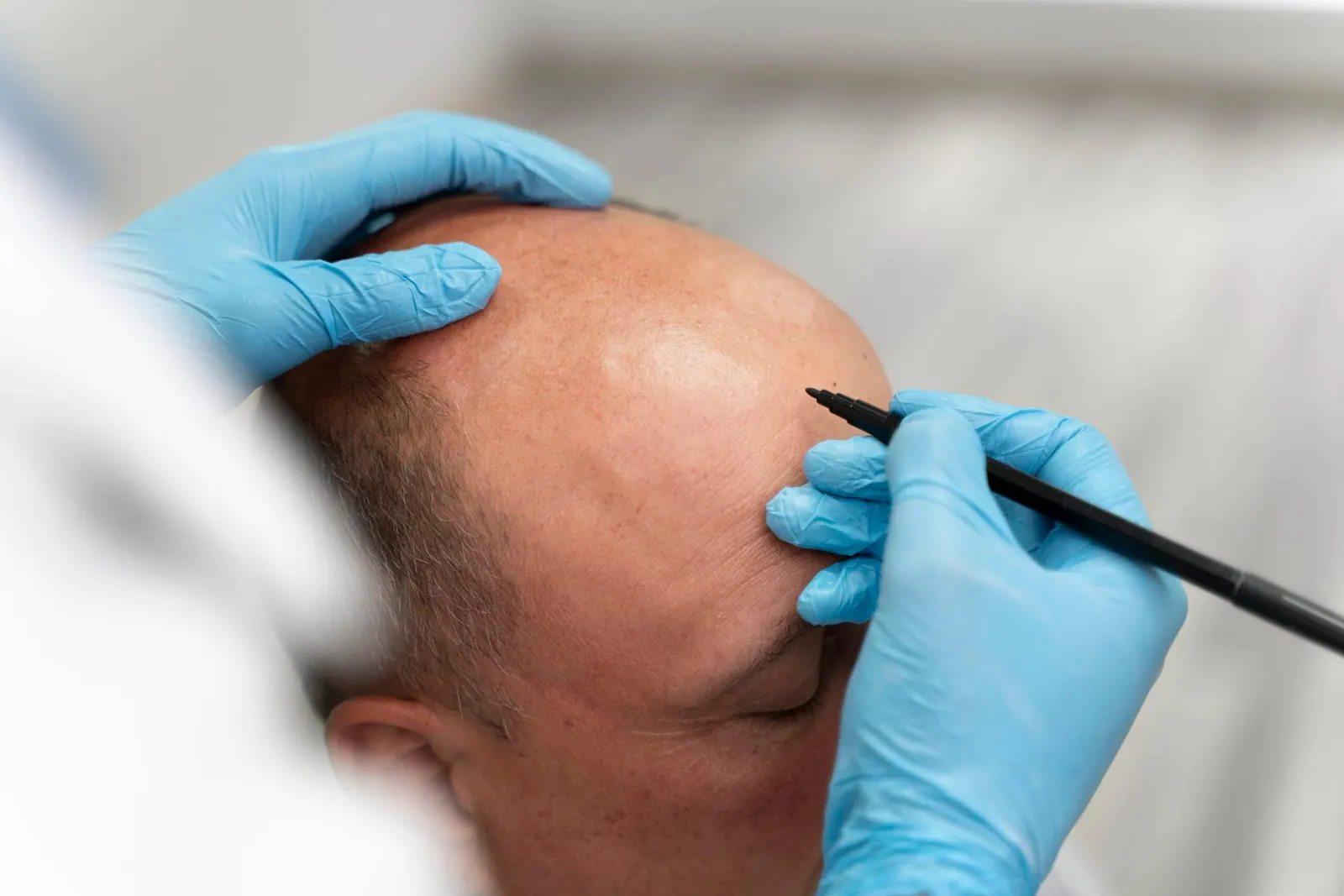
The beard is drawn on your face before the procedure. The cheek line sets how high the beard sits on the face, the neckline where it ends under the jaw, and the transitions decide whether moustache, goatee and sideburns join up. These lines are agreed with you and checked in the mirror, because they change the shape of the face.
Facial hair grows at very flat angles, and its direction changes across the cheeks, jaw and chin. Placing each graft at the local angle and direction is what makes a transplanted beard look grown rather than planted, and why the density near the edges is kept softer than in the centre of the beard.
Schnurrbarttransplantation
Bei einer Schnurrbarttransplantation werden Ihre eigenen Follikel – meist vom Hinterkopf und von den Seiten des Kopfes – in die Oberlippe verpflanzt, um Lücken oder eine Narbe aufzufüllen oder einen volleren Schnurrbart aufzubauen. Die Oberlippe ist ein kleiner Bereich, der kaum Fehler verzeiht: Die Haare wachsen hier in besonders flachen Winkeln und fächern sich von der Mitte der Lippe zu den Mundwinkeln hin auf. Deshalb werden überwiegend Einzelhaar-Grafts einzeln gesetzt, jeweils im Winkel und in der Richtung der jeweiligen Stelle.
Kopfhaar ähnelt dem Haar der Oberlippe stark, ist aber nicht identisch; die Planung berücksichtigt daher auch Struktur und Farbe, und ein Schnurrbart wird oft zusammen mit Bart, Kinnbart oder Koteletten geplant. Design und Graft-Anzahl werden bei einer persönlichen Untersuchung festgelegt.
Kotelettentransplantation
Koteletten rahmen das Gesicht ein. Lücken durch Veranlagung, Narben oder frühere Haarentfernung lassen sich mit Ihren eigenen Follikeln auffüllen, die meist vom Hinterkopf entnommen und so ausgewählt werden, dass sie zu Ihrer Gesichtsbehaarung passen. Winkel und Richtung sind entscheidend für ein natürliches Aussehen, und Form und Kontur werden gemeinsam mit Ihnen entworfen, nicht nach Schablone.
Because sideburns connect the hairline to the beard, they are usually planned together with any beard or hairline work, so the whole frame and the use of donor hair are planned as one.
Barttransplantation vorher und nachher: realistische Erwartungen
Consented cases labelled as beard work. Look at the lines and the density near the edges, and at how many months after the procedure each photo was taken.
Combined before/after image. Consented imagery — individual results vary.
Shaving and healing: the first weeks with a new beard
The donor area on the scalp is usually trimmed for the procedure; the face may be trimmed short so the existing hair does not hide the planned lines. Afterwards, small crusts form around each graft on the face and usually fall away within the first week or two. Redness and some swelling are common in the first days.
Do not shave or trim the treated areas until your clinic says you can, and avoid rubbing them while washing. The transplanted beard hairs often shed in the first weeks and grow back over the following months, so the new beard fills in gradually. Once it has grown, the transplanted hairs can be shaved, trimmed and styled like the rest of your beard.
How much does a beard transplant cost?
Beard, moustache and sideburn transplants are priced after an assessment, because the areas, the density you want and the donor hair available differ too much between people for a fixed package. They are not covered by the scalp hair transplant packages.
FAQ zur Barttransplantation in der Türkei
Can I shave my beard after a transplant?
Can a beard transplant cover a scar?
Was ist eine Barttransplantation?
Will the transplanted beard hair look different from my own?
Kann man eine Barttransplantation machen lassen?
Sources & further reading
- International Society of Hair Restoration Surgery (ISHRS)
- American Academy of Dermatology
- NHS (United Kingdom)
This content is for general information only and does not replace a personal medical consultation. Any procedure carries risks that are discussed during your assessment; individual results vary.
Related pages
 GuideEyebrow Transplant in TurkeyEyebrow restoration for thin, over-plucked o…Read the guide
 GuideHair Transplant in Turkey: Costs, Techniques and ResultsFUE, DHI and Sapphire FUE hair transplants i…Read the guide GuideHair Restoration Treatments in TurkeyEvery hair restoration option in one place —…Read the guide
 GuideAfro Hair Transplant in TurkeyAfro-textured hair transplants require speci…Read the guide
 GuideFemale Hair Transplant in TurkeyHair transplants for women — diffuse thinnin…Read the guide
 GuideHairline Transplant in TurkeyHairline design and restoration — a natural,…Read the guide
 GuideCrown Hair Transplant in TurkeyCrown (vertex) restoration — how the whorl p…Read the guide GuideTemple Hair Transplant in TurkeyTemple-point restoration to reframe the face…Read the guide
Want to see your beard lines drawn?
Send a few photos for a free assessment. We look at your donor area and your beard, suggest the lines and explain the next steps — with no obligation.